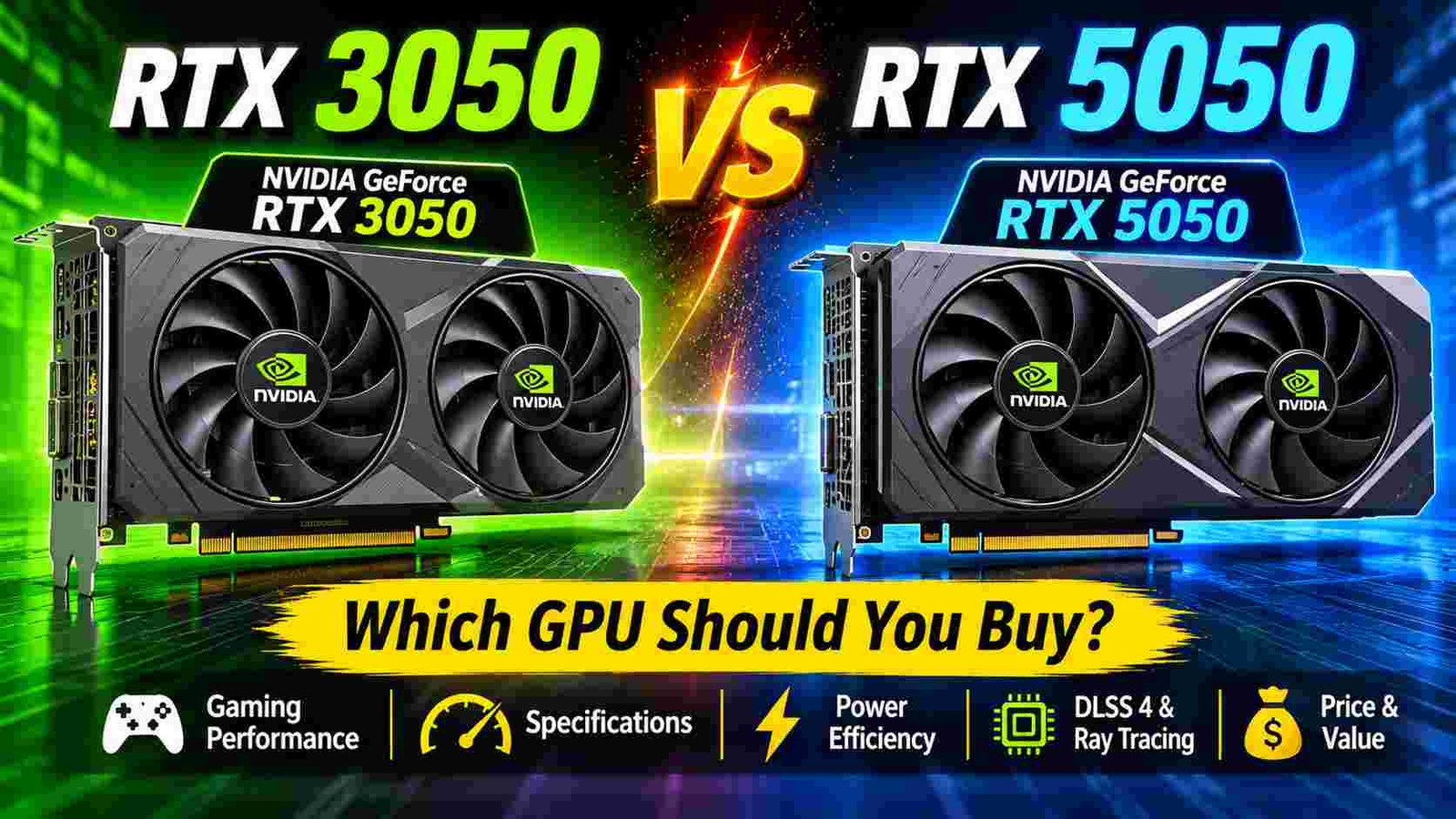
RTX 3050 vs RTX 5050 – NVIDIA GeForce : Complete Comparison of Specifications, Gaming Performance, Power Efficiency and Features
Choosing the right graphics card is an important decision for gamers, video editors, content creators and PC enthusiasts. NVIDIA has introduced several generations of GeForce RTX graphics cards, bringing improvements in gaming performance, artificial intelligence, ray tracing and power efficiency.
Two graphics cards that attract attention in the entry-level gaming segment are the NVIDIA GeForce RTX 3050 and NVIDIA GeForce RTX 5050.
The RTX 3050 belongs to NVIDIA’s older RTX 30 Series, while the RTX 5050 is part of the newer RTX 50 Series, based on the Blackwell architecture. Although both graphics cards offer 8GB memory configurations, their underlying technologies and capabilities are quite different.
But does the newer RTX 5050 really offer enough improvement to justify upgrading? Is the RTX 3050 still good for gaming? Which one is better for video editing, AI applications and everyday computing?
Let’s compare both graphics cards in detail to help you make the right buying decision.
Table of Contents
1. NVIDIA RTX 3050 vs RTX 5050: Introduction and Origin
Before comparing their specifications, it is important to understand when these graphics cards were introduced and what technologies they represent.
NVIDIA GeForce RTX 3050
The NVIDIA GeForce RTX 3050 was introduced in January 2022 as an affordable graphics card in the RTX 30 Series.
It is based on NVIDIA’s Ampere architecture, which brought second-generation Ray Tracing cores and third-generation Tensor cores.
The RTX 3050 was designed mainly for budget-conscious gamers who wanted to experience ray tracing, DLSS technology and modern PC gaming without purchasing an expensive graphics card.
The desktop RTX 3050 is available in two important configurations:
- RTX 3050 8GB – The original, more powerful configuration.
- RTX 3050 6GB – A later, reduced-power version introduced in 2024.
These versions have different CUDA core counts, memory bandwidth and power requirements.
NVIDIA GeForce RTX 5050
The NVIDIA GeForce RTX 5050 is a newer entry-level graphics card introduced in June 2025, with desktop cards becoming available from July 2025.
It belongs to the RTX 50 Series and uses NVIDIA’s latest-generation Blackwell architecture.
The RTX 5050 is designed to provide improved gaming performance, advanced ray tracing, AI-powered graphics and better support for modern applications.
Its important technologies include:
- Fifth-generation Tensor cores.
- Fourth-generation Ray Tracing cores.
- DLSS 4 technology.
- Multi Frame Generation.
- Ninth-generation NVIDIA Encoder (NVENC).
- PCI Express 5.0 support.
Unlike the RTX 3050, the RTX 5050 desktop version comes with 8GB GDDR6 memory.
2. RTX 3050 vs RTX 5050: Complete Specifications Comparison
Specifications are one of the most important factors when selecting a graphics card. They help us understand the processing capability, memory performance, power consumption and technology supported by each GPU.
Here is a detailed comparison of their desktop specifications.
| Specifications | RTX 3050 8GB | RTX 3050 6GB | RTX 5050 8GB |
|---|---|---|---|
| GPU Series | RTX 30 Series | RTX 30 Series | RTX 50 Series |
| Architecture | Ampere | Ampere | Blackwell |
| Launch Year | 2022 | 2024 | 2025 |
| CUDA Cores | 2,560 | 2,304 | 2,560 |
| Boost Clock | 1,777 MHz | 1,470 MHz | 2,570 MHz |
| Memory | 8GB | 6GB | 8GB |
| Memory Type | GDDR6 | GDDR6 | GDDR6 |
| Memory Bus | 128-bit | 96-bit | 128-bit |
| Memory Bandwidth | 224 GB/s | 168 GB/s | 320 GB/s |
| Ray Tracing Cores | 2nd Gen | 2nd Gen | 4th Gen |
| Tensor Cores | 3rd Gen | 3rd Gen | 5th Gen |
| DLSS | DLSS 2 | DLSS 2 | DLSS 4 |
| PCIe Interface | PCIe 4.0 x8 | PCIe 4.0 x8 | PCIe 5.0 x8 |
| Graphics Card Power | 130W | 70W | 130W |
| Recommended System Power | 550W | 300W | 550W |
Important: Specifications are based on NVIDIA’s reference configurations. Actual clock speeds, cooling systems and dimensions can vary between manufacturers such as ASUS, MSI, Gigabyte, Zotac and others.
Specification verdict: The RTX 5050 has a major advantage in memory bandwidth, clock speed and newer processing technologies. However, the RTX 3050 8GB and RTX 5050 have the same CUDA core count, which shows that core count alone does not determine graphics performance.
3. Architecture: Ampere vs Blackwell
One of the biggest differences between these two graphics cards is their GPU architecture.
RTX 3050: Ampere Architecture
The RTX 3050 uses NVIDIA’s Ampere architecture.
Ampere introduced significant improvements over earlier GPU generations, especially in ray tracing and AI processing.
Its major features include:
- Second-generation Ray Tracing cores.
- Third-generation Tensor cores.
- Support for DLSS 2.
- Hardware-accelerated ray tracing.
- NVIDIA Studio support.
The Ampere architecture still provides useful performance for everyday gaming, video editing and creative applications.
However, it is an older generation, and it lacks some of the advanced AI graphics features introduced in newer GPUs.
RTX 5050: Blackwell Architecture
The RTX 5050 uses NVIDIA’s Blackwell architecture, which brings improvements in graphics processing and AI capabilities.
Its important features include:
- Fourth-generation Ray Tracing cores.
- Fifth-generation Tensor cores.
- DLSS 4 with Multi Frame Generation.
- Improved AI processing capabilities.
- Ninth-generation NVENC encoder.
- Newer display and connectivity standards.
The Blackwell architecture is particularly useful for modern games and applications that take advantage of AI-powered graphics technologies.
Which architecture is better?
The RTX 5050 clearly wins this comparison because Blackwell offers newer hardware and software capabilities. However, the actual performance improvement depends on the application and whether it supports the newer technologies.
4. Gaming Performance: RTX 3050 vs RTX 5050
Gaming performance is probably the biggest reason people compare these two graphics cards.
The RTX 3050 was designed primarily for affordable 1080p gaming. It can handle many popular games at reasonable settings, although demanding modern titles may require reduced graphics quality.
The RTX 5050 is designed to offer a better 1080p gaming experience, with additional support for advanced graphics features.
Gaming performance differences
| Gaming Factor | RTX 3050 | RTX 5050 |
|---|---|---|
| 1080p Gaming | Good for lighter and older games | Better overall experience |
| 1440p Gaming | Limited in demanding games | More capable, with compromises |
| Ray Tracing | Basic to moderate | Improved hardware support |
| DLSS | DLSS 2 | DLSS 4 |
| Frame Generation | No NVIDIA Frame Generation | Multi Frame Generation |
| Competitive Gaming | Suitable | Better potential for higher frame rates |
| Modern AAA Games | Requires compromises | Better suited to modern titles |
NVIDIA has claimed that the RTX 5050 delivers approximately 60% higher average raster performance than the RTX 3050 8GB in its selected gaming comparisons.
NVIDIA also advertises up to four times the performance in selected games using the full DLSS 4 feature set, including Multi Frame Generation.
However, these figures should not be interpreted as universal results. Actual gaming performance depends on the game, resolution, graphics settings, CPU, drivers and supported DLSS features.
5. VRAM and Memory Bandwidth: Which Graphics Card Is Better?
VRAM stands for Video Random Access Memory. It is the dedicated memory used by a graphics card to store textures, graphics data, frame buffers and other information required for rendering.
Both the RTX 3050 8GB and RTX 5050 have 8GB GDDR6 memory.
At first glance, their memory capacity looks identical. However, their memory bandwidth is different.
| Memory Specification | RTX 3050 8GB | RTX 5050 8GB |
|---|---|---|
| Memory Capacity | 8GB | 8GB |
| Memory Type | GDDR6 | GDDR6 |
| Memory Bus | 128-bit | 128-bit |
| Memory Speed | 14 Gbps | 20 Gbps |
| Memory Bandwidth | 224 GB/s | 320 GB/s |
The RTX 5050 offers approximately 43% higher memory bandwidth than the RTX 3050 8GB.
This helps the GPU transfer data more quickly between its memory and processing units.
It can be beneficial for:
- High-resolution textures.
- Modern gaming workloads.
- Graphics rendering.
- Video editing.
- Memory-intensive applications.
However, higher bandwidth does not mean the RTX 5050 has more VRAM. Both cards have 8GB, so extremely demanding games and professional workloads can still encounter memory limitations.
Memory verdict: The RTX 5050 wins because of its higher memory bandwidth, although both cards have the same 8GB capacity.
6. Ray Tracing and DLSS: A Major Technological Difference
Ray tracing and DLSS are two important NVIDIA technologies that improve the gaming experience.
Ray Tracing
Ray tracing creates realistic lighting, reflections and shadows by simulating the behaviour of light.
For example, in a game with ray tracing enabled, you may see more realistic reflections on water, glass, vehicles and buildings.
The RTX 3050 supports ray tracing through its second-generation RT cores.
The RTX 5050 uses fourth-generation RT cores, offering newer ray-tracing hardware and improved capabilities.
While both graphics cards support ray tracing, the RTX 5050 is better equipped for modern ray-traced games.
DLSS Technology
DLSS stands for Deep Learning Super Sampling.
It uses artificial intelligence to improve gaming performance by rendering images at a lower internal resolution and reconstructing them at a higher output resolution.
The RTX 3050 supports DLSS 2 Super Resolution.
The RTX 5050 supports DLSS 4 features, including:
- DLSS Super Resolution.
- DLAA.
- Ray Reconstruction.
- Frame Generation.
- Multi Frame Generation.
One important advantage of the RTX 5050 is Multi Frame Generation, which can generate additional frames using AI in supported games.
This can make gameplay appear smoother.
However, generated frames are not the same as additional traditionally rendered frames. They do not automatically improve input responsiveness in the same way as higher native frame rates.
Technology verdict: The RTX 5050 is the clear winner for gamers who want modern AI-powered graphics and advanced ray tracing features.
7. Power Consumption and Energy Efficiency
Power consumption is another important factor when purchasing a graphics card.
A GPU with higher performance but excessive power requirements may increase electricity costs and require a more expensive power supply.
Let’s compare the power requirements.
| Power Specification | RTX 3050 8GB | RTX 3050 6GB | RTX 5050 |
|---|---|---|---|
| Graphics Card Power | 130W | 70W | 130W |
| Recommended PSU | 550W | 300W | 550W |
| Power Connector | 8-pin | No additional connector | 8-pin |
Interestingly, the RTX 5050 and RTX 3050 8GB have the same reference graphics card power rating of 130W.
However, the RTX 5050 offers considerably better performance.
This means it can deliver more gaming performance for a similar rated power budget.
The RTX 3050 6GB is different because it consumes only 70W, making it attractive for lower-power PC builds.
Which is more energy efficient?
For performance per watt, the RTX 5050 has the advantage over the RTX 3050 8GB.
The RTX 3050 6GB may still be a better option for systems where low power consumption is more important than gaming performance.
Actual electricity consumption depends on workload, system configuration, power limits and usage time.
8. Video Editing, Streaming and Content Creation
Graphics cards are not used only for gaming. They also play an important role in video editing, graphic design, animation and content creation.
Both graphics cards support NVIDIA Studio technologies and hardware-accelerated creative applications.
RTX 3050 for content creators
The RTX 3050 can be useful for:
- Basic video editing.
- YouTube video production.
- Photoshop and graphic design.
- Basic 3D modelling.
- Streaming.
- Rendering smaller projects.
Its seventh-generation NVENC encoder provides hardware-accelerated video encoding.
For beginner content creators, it can still be a practical budget option.
RTX 5050 for content creators
The RTX 5050 provides newer hardware capabilities that can benefit content creators.
Its ninth-generation NVENC encoder and newer video decoding hardware improve its multimedia feature set.
It is useful for:
- Video editing.
- Streaming.
- AI-assisted creative applications.
- 3D modelling.
- Graphics rendering.
- Content production.
However, professional users should remember that the RTX 5050 still has only 8GB VRAM.
For demanding 4K video projects, complex 3D scenes and large AI workloads, a GPU with more VRAM may be a better investment.
Content creation verdict: The RTX 5050 is the more capable option, but the RTX 3050 remains suitable for basic editing and everyday creative tasks.
9. AI Performance and Machine Learning Capabilities
Artificial intelligence is becoming increasingly important in modern computing.
Graphics cards are used for AI image generation, machine learning, video enhancement, AI-assisted editing and other computational tasks.
NVIDIA’s RTX graphics cards use Tensor cores to accelerate supported AI workloads.
The RTX 3050 features third-generation Tensor cores, while the RTX 5050 includes fifth-generation Tensor cores.
According to NVIDIA’s published specifications:
| AI Specification | RTX 3050 | RTX 5050 |
|---|---|---|
| Tensor Core Generation | 3rd Generation | 5th Generation |
| AI Performance | 73 AI TOPS | 421 AI TOPS |
AI TOPS represents theoretical AI processing capability under specified precision conditions.
The figures should not be treated as a direct measurement of real-world application performance because different GPU architectures and workloads use different precision formats and software optimisations.
The RTX 5050 has a major advantage in AI hardware capabilities.
However, users planning to run large local AI models should also consider memory capacity. Its 8GB VRAM can be restrictive for larger models.
AI verdict: The RTX 5050 is clearly more advanced for supported AI workloads, but neither card should be considered a high-end AI workstation GPU.
10. Display Connectivity and Modern Features
Connectivity determines how a graphics card communicates with monitors and other PC components.
The RTX 3050 supports PCIe 4.0 x8, while the RTX 5050 supports PCIe 5.0 x8.
The RTX 5050 also introduces newer display connectivity standards.
| Feature | RTX 3050 | RTX 5050 |
|---|---|---|
| PCIe Interface | Gen 4 x8 | Gen 5 x8 |
| DisplayPort | 1.4a | 2.1b |
| HDMI | HDMI 2.1 | HDMI 2.1b |
| NVIDIA Reflex | Supported | Reflex 2 support |
| NVIDIA Broadcast | Supported | Supported |
| NVIDIA Studio | Supported | Supported |
| G-SYNC | Supported | Supported |
These features make the RTX 5050 more suitable for modern display setups and newer gaming technologies.
However, the actual display resolution and refresh rate supported depend on the graphics card manufacturer’s implementation, monitor and cable.
11. Price and Value for Money
Price is often the deciding factor when purchasing a graphics card.
At launch, NVIDIA announced a starting price of $249 for the RTX 5050 desktop graphics card.
The RTX 3050 8GB originally launched at $249 in 2022, while the RTX 3050 6GB arrived later as a lower-power and lower-specification variant.
However, launch prices are not the same as current retail prices.
In India, actual prices can vary depending on:
- Brand and model.
- Cooling system.
- Factory overclocking.
- Retailer discounts.
- Availability.
- Warranty and after-sales support.
When comparing prices, check the exact model and memory configuration rather than comparing only the RTX 3050 and RTX 5050 names.
The RTX 5050 is generally worth considering when its price is reasonably close to competing alternatives with similar performance.
If an RTX 3050 8GB is available at a substantial discount, it may still offer reasonable value for a budget PC.
12. Advantages and Disadvantages of Both Graphics Cards
NVIDIA RTX 3050: Advantages
- More affordable in the used and discounted market.
- Suitable for basic 1080p gaming.
- Supports ray tracing and DLSS 2.
- Useful for beginner video editing.
- The 6GB version offers low 70W power consumption.
- Supports NVIDIA Studio drivers and applications.
- Can be suitable for upgrading older desktop PCs.
NVIDIA RTX 3050: Disadvantages
- Older Ampere architecture.
- Lower memory bandwidth.
- Older-generation Tensor and RT cores.
- No NVIDIA Multi Frame Generation.
- Limited performance in demanding modern games.
- The 6GB version has significantly reduced specifications.
- Less future-ready than newer GPU generations.
NVIDIA RTX 5050: Advantages
- Newer Blackwell architecture.
- Higher memory bandwidth.
- Fifth-generation Tensor cores.
- Fourth-generation Ray Tracing cores.
- Supports DLSS 4 and Multi Frame Generation.
- Better gaming performance.
- Newer NVENC and NVDEC hardware.
- Improved AI processing capabilities.
- PCIe 5.0 and DisplayPort 2.1b support.
NVIDIA RTX 5050: Disadvantages
- Still limited to 8GB VRAM.
- Higher purchase cost than many discounted RTX 3050 models.
- Requires a suitable 130W graphics card power configuration.
- Multi Frame Generation is not supported in every game.
- Not ideal for demanding professional workloads requiring large VRAM capacity.
- Not designed for high-end 4K gaming.
13. Which Graphics Card Should You Buy?
Now comes the most important question: Which graphics card should you actually purchase?
The answer depends on your budget and how you plan to use your computer.
Choose RTX 3050 if:
- You have a very limited budget.
- You mainly play older or less demanding games.
- You want an affordable entry-level graphics card.
- You need a GPU for basic video editing.
- You are purchasing the 6GB version for a low-power PC.
- You find a significantly cheaper RTX 3050 8GB model.
Choose RTX 5050 if:
- You want better 1080p gaming performance.
- You play modern AAA games.
- You want newer DLSS and AI features.
- You use graphics-intensive applications.
- You want better ray-tracing capabilities.
- You are building a new gaming PC.
- You want a more future-ready GPU.
What if you already own an RTX 3050?
If you already have an RTX 3050 8GB, upgrading to an RTX 5050 can provide a noticeable improvement, particularly in supported modern games.
However, before upgrading, compare the RTX 5050’s actual retail price with other available graphics cards.
If you are building a completely new PC, also consider whether spending a little more on a higher-performance GPU would provide better long-term value.
14. Final Verdict: RTX 3050 vs RTX 5050
The NVIDIA GeForce RTX 3050 and RTX 5050 are both entry-level graphics cards, but they belong to different generations of GPU technology.
The RTX 3050 remains a reasonable option for budget-conscious users who want basic gaming and everyday graphics performance.
However, the RTX 5050 brings significant improvements in architecture, memory bandwidth, ray tracing, AI processing and gaming technologies.
Although both the RTX 3050 8GB and RTX 5050 have 2,560 CUDA cores and 8GB GDDR6 memory, the RTX 5050’s newer architecture and higher clock speeds help it deliver better overall performance.
Our recommendation: If your budget allows, the RTX 5050 is the better choice for a new gaming PC in 2026. It offers newer technologies, better performance and improved support for modern games and applications.
However, if you find an RTX 3050 8GB at a considerably lower price and your requirements are limited to basic 1080p gaming, it can still be a sensible budget purchase.
Ultimately, the best graphics card is not necessarily the newest or most expensive one. It is the one that delivers the right performance for your needs at a price you can comfortably afford.
Frequently Asked Questions (FAQs)
1. Is RTX 5050 better than RTX 3050?
Yes. The RTX 5050 is generally faster and offers newer architecture, improved ray tracing, higher memory bandwidth and DLSS 4 support.
2. Is RTX 5050 good for gaming?
Yes. It is a capable entry-level GPU for 1080p gaming. It can run many modern games with appropriate graphics settings.
3. Does RTX 5050 have 8GB VRAM?
Yes. The desktop RTX 5050 comes with 8GB GDDR6 video memory and a 128-bit memory interface.
4. Is RTX 3050 still worth buying in 2026?
It can be worth buying if you find it at a significantly discounted price and mainly need basic gaming or everyday graphics performance.
5. Can RTX 5050 run modern AAA games?
Yes. It can run modern AAA games, particularly at 1080p, although demanding games may require reduced settings or DLSS.
6. Which is better for video editing, RTX 3050 or RTX 5050?
The RTX 5050 is generally better because of its newer architecture, AI capabilities and ninth-generation NVENC encoder.
7. Does RTX 5050 support DLSS 4?
Yes. The desktop RTX 5050 supports DLSS 4 features, including Multi Frame Generation in compatible games.
8. Is RTX 5050 more power efficient than RTX 3050?
Compared with the RTX 3050 8GB, the RTX 5050 offers better performance at the same reference graphics card power rating of 130W.
9. Can I use RTX 5050 with an older motherboard?
Generally, yes. PCIe is backward compatible. However, check motherboard compatibility, physical clearance, BIOS requirements and power supply connections.
10. Is 8GB VRAM enough for gaming in 2026?
8GB is sufficient for many 1080p games, but some demanding modern games may require reduced texture settings. Users planning high-resolution gaming or professional workloads may benefit from a graphics card with more VRAM.
Disclaimer: Graphics card performance varies depending on the PC configuration, drivers, cooling system, game settings and software optimisation. Specifications and launch prices are based on publicly available manufacturer information. Always verify the exact model specifications and current retail price before purchasing.
Follow us for more captivating articles and stay connected to explore the world. Let’s embrace the power of communication and understanding.

Related topics:
School Site :
For English grammar and lot more : Smart School Infolips

Marathi Poems: Marathi Rang
Technology : Tech Site